Five Weeks of Change—Academic Stress, Self-Stigma, and Anxiety
A longitudinal study compared academically struggling and high-achieving students, revealing distinct pathways linking stress, self-evaluation, and anxiety over time.

Anxiety, academic stress, and self-stigma often co-occur, but they do not necessarily influence one another in the same way. A longitudinal study led by Minqi Yang and collaborators was published online in Depression and Anxiety on 24 April 2026.
Why follow change over time?
Cross-sectional surveys can show that psychological states are associated, but not which state tends to precede another. The team therefore conducted two surveys, five weeks apart, across five high schools in Liaoning Province. Of 3,000 students at baseline, 2,613 completed both waves. Analyses focused on 735 academically struggling students and 733 high-achieving students.
Different pathways across groups
Among academically struggling students, earlier anxiety predicted later academic stress, while anxiety and self-stigma showed reciprocal associations. Among high-achieving students, the reciprocal link between academic stress and anxiety was more prominent. The findings indicate that strong academic performance should not be treated as evidence of psychological well-being.
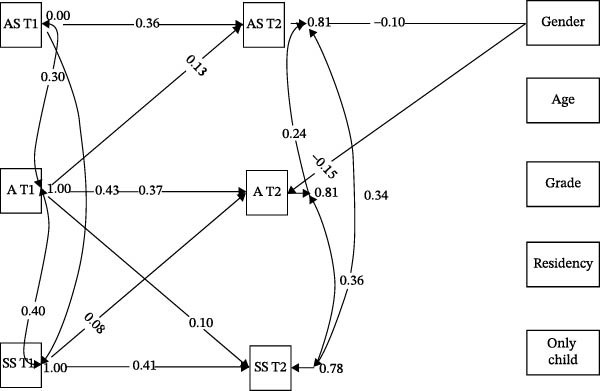
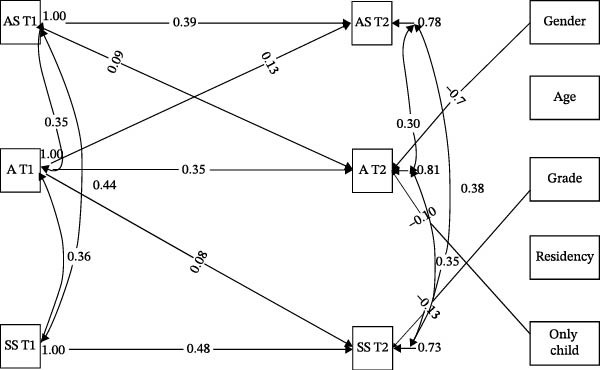
Figures 1–2 from the paper: significant pathways for academically struggling students (left) and high-achieving students (right). AS=academic stress, A=anxiety, SS=self-stigma. Source: Yang et al., Depression and Anxiety, 2026.
The results support differentiated school-based interventions: reducing shame and self-stigma may be especially relevant for struggling students, whereas high achievers may benefit from interrupting cycles in which performance pressure and anxiety reinforce one another. Because the study relied on self-report and covered five weeks, the findings describe short-term predictive relationships rather than definitive causal effects.